
lesson
A particle model explains different behaviour
1 · Learn
In a simple model, solid particles vibrate around fixed positions; liquid particles remain close but move past one another; gas particles are widely separated and move freely between collisions. The particles themselves do not become soft when a solid melts.
A gas compresses readily because the spaces between particles can decrease. A liquid is difficult to compress because its particles are already close. Model circles show particles, not necessarily their real shape or colour.
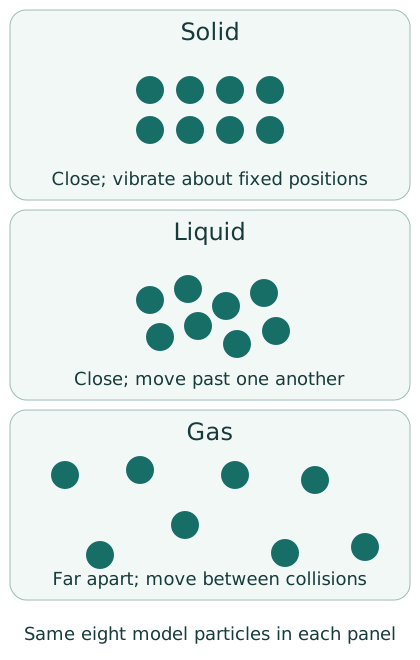
2 · Worked example
I explain a gas filling a container through particle motion in all directions. I do not say gas particles deliberately seek the empty corners.
3 · Your turn
Why is a gas much easier to compress than a liquid in this model?
Check your answer
There is much more space between gas particles, allowing them to move closer together.
4 · Apply your learning
Draw equal numbers of model particles for each state and annotate motion as well as arrangement.
Adult guidance and safety
Use supplied data and diagrams unless a qualified adult has approved the practical, equipment and risk assessment. No tasting substances, culturing unknown microbes, mains electricity, flames or hazardous chemical experiments at home. Models simplify reality; ask which assumptions affect the conclusion.
Open your writing and drawing pad
Write, draw or show your working. Use a mouse, pen or finger. This pad is not a submitted answer.
Not saved to your account. Download your drawing as PNG and your typed notes as TXT before leaving or refreshing. They are separate files. Do not enter private information.
Open a picture saved on this device to draw on it again. Opening replaces the drawing, but Undo can restore it. PNG only, up to 4 MB and 4096 × 4096 pixels. The picture stays in this browser; it is not uploaded. Paper lines in a saved picture become part of that picture.
Clear the drawing? Your typed notes will stay. You can undo this action.
Your pad is empty.
Open a UTF-8 TXT file from this device, up to 40 KB and 10,000 characters. It stays in this browser. Opening can be undone until you type again. Downloads keep a new copy; they do not change the file you opened.
Replace the notes on this page with the opened file? Download the current notes first if you want to keep them.
Typed notes are not submitted answers.
Check a calculation · Year 5 onward
Use this only when your teacher or adult allows a calculator for the task. Show your thinking first. It does not replace mental or written arithmetic and does not mark your lesson answer.
Powers, roots and trigonometry · Year 7 onward
Use only when the task allows a calculator. Choose one operation at a time and record your working. Trigonometry here always uses degrees (DEG), not radians. Inverse sine, cosine and tangent return an angle, not a reciprocal. Keep exact fractions and π in answers when requested.
Approximate numerical results use up to 12 significant digits. Inverse sine returns −90° to 90°, inverse cosine 0° to 180°, and inverse tangent −90° to 90°; these are principal values, not every possible solution of a trigonometric equation.
My observation notebook
Follow your teacher's approved method and safety instructions. Record the sample or supplied dataset, conditions, measurements with units and uncertainties where appropriate. Distinguish observations from explanations. A described experiment is not permission to carry it out; do not improvise equipment or invent missing results.
Ask your teacher for support with the method and recording. A prediction is what you think might happen; an observation is what you actually see, hear or feel safely.
Keep your notebook: use Download notebook before leaving. Nothing is sent to the website or saved to your account. Reopen the downloaded notebook here to add another day's record. Do not include names, addresses or other private information.
Your records on this page
No observations recorded yet. Look first, then add one.
Reopening adds records; it does not replace your current records. Up to 50 records per notebook. Keep your downloads somewhere private. Editing this notebook does not submit work or complete a lesson.
Practice this lesson
Lesson resources
Browse the available practice activities and worksheets for this lesson.
Your progress